







Pain in the butt! (well they are) If you suffer from hemorrhoids then that is what you are going through often. And the people who are referred to my practice come through the door often walking slowly and sitting gingerly are tired of dealing with the constant pain in the patootie.
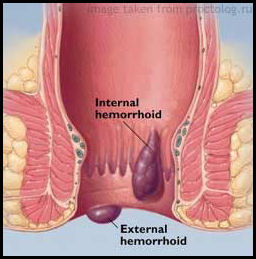
What are hemorrhoids? A precise definition of hemorrhoids does not exist, but they can be described as masses or clumps (“cushions”) of tissue within the anal canal that contain blood vessels and their surrounding, supporting tissue made up of muscle and elastic fibers. The anal canal is the last four centimeters through which stool passes as it goes from the rectum to the outside world. The anus is the opening of the anal canal to the outside world.
Although most people think hemorrhoids are abnormal, they are present in everyone. It is only when the hemorrhoidal cushions enlarge that hemorrhoids can cause problems and be considered abnormal or a disease. Prevalence of hemorrhoids
Although hemorrhoids occur in everyone, they become large and cause problems in only 4 percent of the general population. Hemorrhoids that cause problems are found equally in men and women, and their prevalence peaks between 45 and 65 years of age.
What causes hemorrhoids? It is not known why hemorrhoids enlarge. There are several theories about the cause, including inadequate intake of fiber, prolonged sitting on the toilet, and chronic straining to have a bowel movement (constipation). None of these theories has strong experimental support. Pregnancy is a clear cause of enlarged hemorrhoids though, again, the reason is not clear. Tumors in the pelvis also cause enlargement of hemorrhoids by pressing on veins draining upwards from the anal canal.
What are the symptoms of hemorrhoids? For convenience in describing the severity of internal hemorrhoids, many physicians use a grading system:
First-degree hemorrhoids: Hemorrhoids that bleed but do not prolapse.
Second-degree hemorrhoids: Hemorrhoids that prolapse and retract on their own (with or without bleeding).
Third-degree hemorrhoids: Hemorrhoids that prolapse but must be pushed back in by a finger.
Fourth-degree hemorrhoids: Hemorrhoids that prolapse and cannot be pushed back in. Fourth-degree hemorrhoids also include hemorrhoids that are thrombosed (containing blood clots) or that pull much of the lining of the rectum through the anus.
How are hemorrhoids diagnosed? Most individuals who have hemorrhoids discover them in one of several ways. They either feel the lump of an external hemorrhoid when they wipe themselves after a bowel movement, note drops of blood in the toilet bowl or on the toilet paper, or feel a prolapsing hemorrhoid (protruding from the anus) after bowel movements.
Severe anal pain may occur when an external hemorrhoid thromboses or a prolapsing internal hemorrhoid becomes gangrenous. Symptoms of anal discomfort and itching may occur, but anal conditions other than hemorrhoids are more likely to cause these symptoms than hemorrhoids. (Hemorrhoids often get a “bum rap” for such symptoms since both hemorrhoids and other anal conditions are common and may occur together. For example, up to 20% of individuals with hemorrhoids also have anal fissures.)
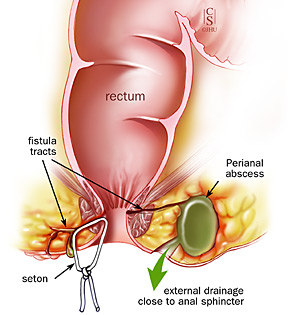
By the history of symptoms, the physician can suspect that hemorrhoids are present. Although the physician should try his or her best to identify the hemorrhoids, it is perhaps more important to exclude other causes of hemorrhoid-like symptoms that require different treatment. These other causes—anal fissures, fistulae, perianal (around the anus) skin diseases, infections, and tumors—can be diagnosed on the basis of a careful examination of the anus and anal canal. If necessary, scrapings of the anus to diagnose infections and biopsies of the perianal skin to diagnose skin diseases can be done.
External hemorrhoids appear as a bump and/or dark area surrounding the anus. If the lump is tender, it suggests that the hemorrhoid is thrombosed. Any lump needs to be carefully followed, however, and should not be assumed to be a hemorrhoid since there are rare cancers of the perianal area that may masquerade as external hemorrhoids.
The diagnosis of an internal hemorrhoid is easy if the hemorrhoid protrudes from the anus. Although a rectal examination with a gloved finger may uncover an internal hemorrhoid high in the anal canal, the rectal examination is more helpful in excluding rare cancers that begin in the anal canal and adjacent rectum. A more thorough examination for internal hemorrhoids is done visually using an anoscope.
How are hemorrhoids treated? Over-the-counter medications for hemorrhoids Many over-the-counter products are sold for the treatment of hemorrhoids. These often contain the same drugs that are used for treating anal symptoms such as itching or discomfort. There are few studies showing that they do anything for hemorrhoids. They probably only reduce the symptoms of hemorrhoids. It is possible, however, that their effectiveness relates to their treatment of anal conditions other than hemorrhoids, for example, idiopathic anal itching, that often accompany hemorrhoids.
GENERAL SURGEON, CERTIFIED BY THE AMERICAN BOARD OF SURGERY